Sorry, you need to enable JavaScript to visit this website.
Skip to main content
How to Care for Your Dog After Surgery
1 min read
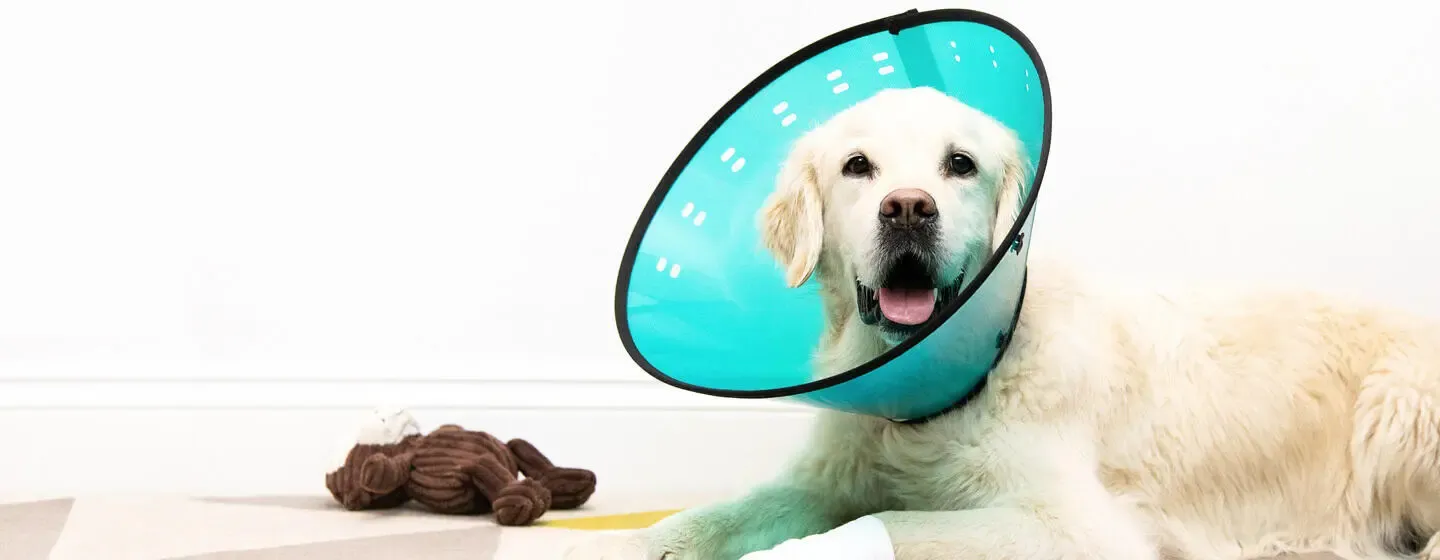
If your four-legged friend has to have surgery, it can be helpful to know what to expect post-dog operation so that you can make your pet as comfortable as possible. Your vet will give you specific advice relating to your particular pet’s ongoing treatment and recovery, to help them get back their usual selves. Dog surgery is a stressful time for the entire family. It’s not just worrying about the operation itself, it’s also what happens once your dog has undergone the procedure. Trying to make them as comfortable as possible as they’re recovering can be a bit daunting. From the anaesthetic effects to keeping your dog’s bandages dry and in place, here is what you can do to help your dog through a speedy recovery. Collecting your dog after surgery When you go to collect your dog after surgery, expect them to be a little sleepy if they’ve had a general anaesthetic. The vet will have given them something small to eat and some painkillers, so they may be a bit wobbly on their feet. You’re likely to be given some dog medication to take home with you such as anti-inflammatories, antibiotics and pain relief. Speak to your vet if you have any questions about how to give them their medicine. When you get them home it’s likely that your dog will just want to head straight to bed to sleep off the effects of the anaesthetic, so make sure they get some peace and quiet without being disturbed. Soon afterwards, they should be pain free, comfortable and happy to eat again. Occasionally the disorientation can cause some dogs to show aggressive behaviour after their operation. This should only be temporary but if it lasts for more than a few hours, it could suggest they’re in pain. If you have any concerns about the dog operation, your pet’s after-care, their aggressive behaviour or their recovery – or if your pet’s not back to normal after 12 hours or so – do get back in touch with your vet. Feeding after dog surgery Feeding your dog after operation will likely be different to the normal routine. Dogs, like humans, can feel nauseous after waking up from an anaesthetic so, after their operation, give your dog a small evening meal of something light, such as cooked chicken or fish. If that's not possible, then feed them just a quarter of their regular food portion. Your vet may give you a specific type of food, developed specially for dogs after surgery. Give them this food for their first few meals, or for as long as your vet recommends but, as soon as possible, get them back onto their normal, high quality food as this will help speed up their recovery. As always, make sure your pet has easy access to clean, fresh water at all times after their dog operation. Exercise as part of your dog’s surgery recovery The usual dog exercise routine will likely have to change as well. Your vet will tell you what sort of exercise your dog can return to, and how soon, depending on the type of dog surgery they’ve had. For example, if your dog had stitches post dog operation, they will need to be kept on a lead and only allowed the very minimum amount of exercise - ideally just a walk in the garden to go to the toilet - until a few days after the stitches have been removed. They will also need to be discouraged from jumping onto furniture and going up and down stairs. Always follow your vet’s instructions on exercise.
How to Bathe a Dog
1 min read
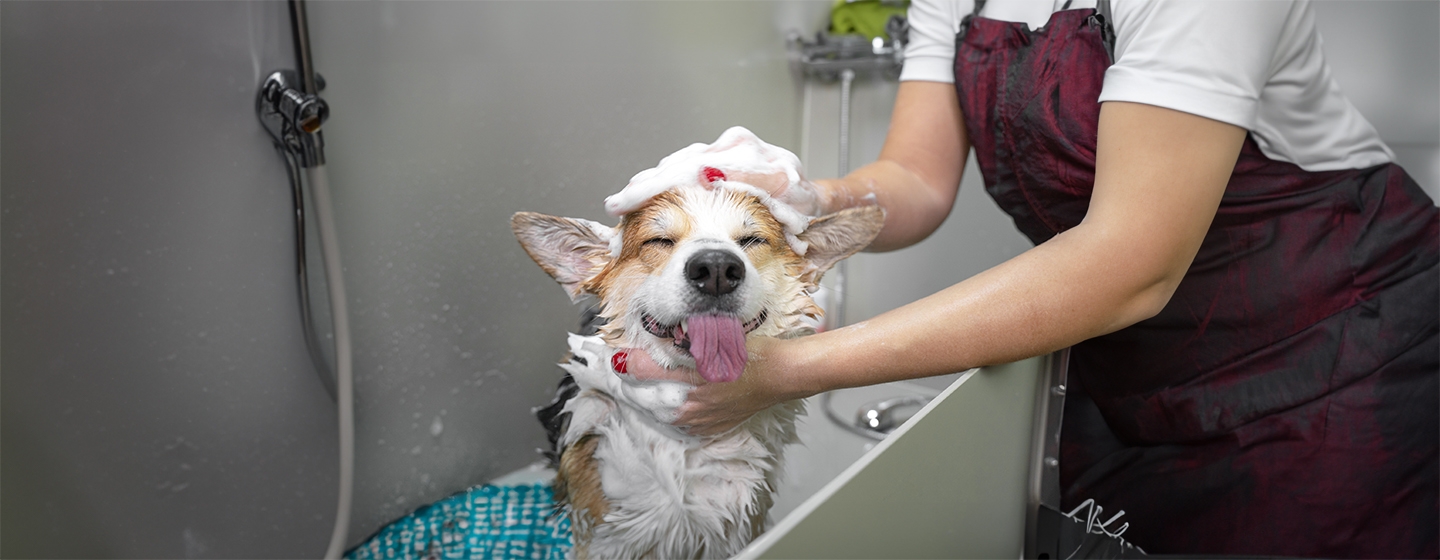
While some dogs don’t mind a warm, soapy bath, there are others dogs who’ll try anything to avoid being in the tub. Whichever category your dog falls into, it’s always good to know how to bathe a dog to avoid creating a big mess in the bathroom. Whether it’s a muddy walk or natural odour, dog bathing is sometimes a necessity so it’s important that you know how to do it properly. How often should you bathe a dog? Unlike people, dogs don’t need daily baths. That said, bathing your dog regularly is a good idea. How often you should bathe your dog depends on the type of dog you have. The good news is that long-haired dogs rarely need more than two to three baths a year, as too much bathing actually removes the natural oils from their coat. A quick paw wash will do most of the time but if your dog has a medical condition, has rolled in something unpleasant, or just smells a bit ‘off’, then a bath is probably on the cards. Most short-haired dogs can also go without being bathed for a long time, unless they get particularly dirty or smelly! For the majority of short-haired dog breeds, bathing once a month is often enough.
How Smart are Cats?
1 min read
Our cats seem extremely intelligent, they always seem to know exactly what we're up to and when their dinner time should be, but how intelligent are they really? Here at Purina we've researched everything you need to know about the topic, keep reading to find out how smart they really are. Cats certainly seem intelligent. Our cats always know exactly what time their breakfast should be and that the sight of the cat carrier means a dreaded trip to the vets. They seem to be able to anticipate our every move and know what we’re thinking, but we never feel like we know what’s going on in their brains. This is largely due to cats being mysterious creatures and the fact that they have eluded scientists because of their reluctance to participate in studies. So, the question still remains: how intelligent are cats? In this article, we take a look at the current research surrounding cat intelligence as well as the age-old debate of if cats are smarter than dogs. Keep reading to learn which are the smartest cat breeds and learn all about the cat mail delivery service in the late 19th century. How intelligent are cats? It turns out that cats have a brain structure that’s similar to other intelligent animals, including humans. It may come as a surprise to learn that your little cat’s brain structure is about 90 percent similar to yours! And according to Psychology Today, a cat’s cerebral cortex – where rational decision making and complex problem solving takes place – has around 300 million neurons. The cerebral cortex is involved in the planning of action, overall interpretation of language and is also responsible for storing both short- and long-term memory, which is why your cat tends to learn by doing rather than seeing. Not only that, but cats also possess more nerve cells in the visual areas of their brain than humans and most other mammals. However, calculating how intelligent cats are depends on how you measure intelligence in the first place.
How Long Do Cats Sleep
How Long Do Cats Sleep?
1 min read
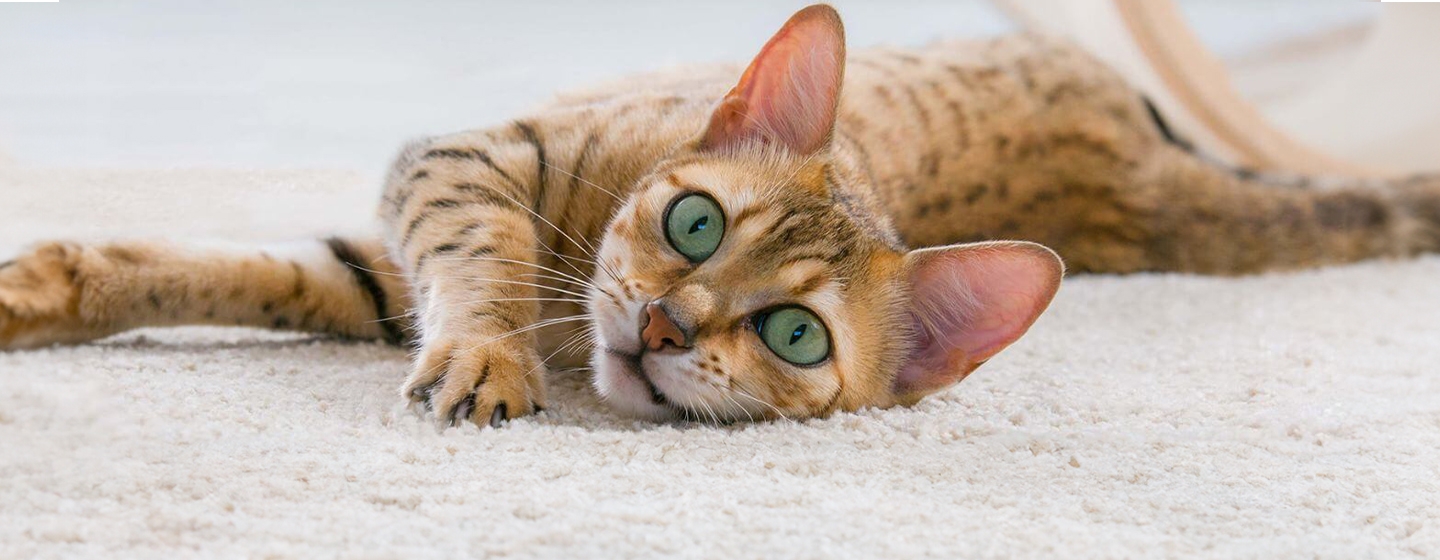
If you’ve witnessed your kitten have a shut eye more frequently than not, you’ve naturally got some questions about your cat’s sleeping patterns. Find out how much sleep our dear feline friends need to feel refreshed and ready to play with their favourite owner. A cat’s sleeping habits can easily puzzle anyone less familiar with the feline lifestyle. For the best part of the day, a cat will act like the retired elderly on a well-deserved holiday, constantly on an all-day snoozing diet. If your cat’s always-off mode makes you feel like the world’s most boring housemate, you’ll be happy to know this is not personal. Cats sleep a lot, naturally. If you’ve been wondering ‘how long do cats sleep?’ and ‘why do cats sleep so much?’, we unpacked some of the amazing facts surrounding their siesta habits to help you better understand your kitty’s unconventional take on sleeping schedules. How long do cats sleep? Cats sleep on average 15 hours a day, with some sleepy kitties getting in up to 20 hours of shut-eye each day.
How long can you leave a cat alone?
1 min read
Although cats are known for their independence, if they are left alone for long periods of time, they can become unhappy. With our busy lives and lots of coming and going from home, it’s no surprise that concerned owners frequently ask themselves ‘how long can you leave a cat alone?’ Most felines will be perfectly content being left alone for the working day while you’re at work. However, longer or more frequent periods of time away, such as full days or nights away from home can be more disruptive. Your cat should not be left alone for long periods of time. It’s important to note that kittens and adult cats are different. Kittens need more regular care and contact, especially in the beginning and when they’re adjusting to their new home. Adult cats are much more self-sufficient during the day. Leaving your cat alone for one day If you’re planning to leave your cat at home for a short period of time such as while you go out to work, there are number of ways that you can make your absence less troubling for your pet. Firstly, make sure they have everything they need for the day such as bowls of fresh water around the house, some food to eat, a comfortable bed and a clean litter tray. Ensure the house is warm and they have plenty of space to move around – try not to shut them up in a single room. While you may not be around personally to entertain your cat, this doesn’t mean that your cat has to go without something to do for the whole day. You can keep your cat active by providing toys like a cat tree, a brain game or open cardboard boxes which can provide your cat with a daily dose of fun. To make them feel less alone, simply leaving the TV on for background noise or using a pheromone plug-in can help your cat to stay calm. If you believe being alone makes your cat anxious, it’s worth testing this to see if they are calmer when you return. How long can cats be left alone when I’m on holiday? It’s important that you don’t leave your cat on their own while you go on holiday for a number of reasons. Access to fresh water, food and companionship are just a few reasons why they shouldn’t be left alone for days on end.
How Do Cats Show Affection?
1 min read
It's a common misconception that cats are not affectionate, mainly because dogs have more explicit ways of demonstrating affection, whereas cats are much more subtle. From head-butting to meowing, find out how your cat shows love! It’s often said that dogs are more affectionate than cats, but that isn’t necessarily the case. It’s true that dogs have more explicit ways of showing their affection—with bounding body language and a big, slobbery tongue for kisses. This can, unfairly, seem as though they might naturally love their owners more than their feline friends. However, while a cat won’t wag their tail (unless they’re angry), that doesn’t mean they don’t feel love! Cats have more subtle ways of making their affection known, and just because they’re naturally more understated, doesn’t mean the bond is any less strong. Find out more about how do cats show affection with this roundup of our all time favourite feline gestures. It will have you purring with delight! How do cats show affection? You might notice that your cat is more inclined to wander around when you’re at home; they might relax in a different part of the house, or simply meander from room to room. Some owners take this as a sign of disinterest and think that their cat doesn’t care whether they’re in the house together, or if they’re left alone. But nothing could be further from the truth! Cats are more likely to explore and interact with their environment when they feel relaxed and comfortable in a person’s presence. So if your pet is often on the move while you’re with them, take it as a subtle sign of how a cat shows affection! The message here is that they are more comfortable in your presence. Body language Body language and more specifically, tail language, is very important when considering how do cats show love. You can tell a lot from the way in which a cat is holding their tail. Often, when showing affection cats use their body and tail as a form of expression. Sometimes by winding their way through your legs, or even just by sitting close enough so that their tail touches you when they swing it. A very happy cat tail position is upright, with a slight curve at the top, which means that they are glad to see you! Similarly, if a cat feels comfortable enough to offer up their belly for a rub, this is the ultimate sign of trust and affection.
Behaviour & Training
Hernias in Dogs: What You Need to Know
1 min read
Hernias can be quite common in dogs, especially in puppies. Our guide tells you the most common types of hernias and the likely treatments used to fix them. Hernias in dogs are relatively common, especially with puppies. Much like in people, a hernia is a condition where the contents of a dog’s abdomen pushes through a tear or hole in the muscle wall or fatty tissue. Over 90% of hernia cases are due to genetics, as puppies are most commonly born with them. However, hernias can also develop as a result of trauma, such as being hit by a car. The severity of hernia in dogs varies depending on where your dog has developed a hernia. This also determines if they are complicated or uncomplicated. Keep reading to find out what the most common types are, the possible symptoms and the methods of treating them.
Hernias in Cats
Hernias in Cats
1 min read
Hernias in cats are quite uncommon but they can still occur, and if they're caught early enough they generally aren't serious. Keep reading to discover everything you need to know about hernias in cats and what you should do if you think your kitty has one. Hernias in cats are quite uncommon but they can still occur, usually either as a result of trauma or most often they’re congenital (meaning they’re born with it). A hernia usually comes about as a result of a muscle defect or damage which allows internal organs and tissue to pass through. There are three different types, categorised by the location of the hernia itself. When caught early on, usually cat hernias aren’t serious, however they may become fatal if they’re left untreated. Keep reading to find out about the different symptoms, types, causes, diagnosis and how cat hernias are most commonly treated. Symptoms of hernias in cats: • A squishy protrusion on your cat’s body • Sickness and vomiting • Lack of appetite • Blood in the urine • Lethargy • Depression Types of cat hernias There are three common hernias that occur in cats and kittens, and they are categorised by the part of the body in which they appear. They can range from complicated – which generally means that surgery will be required, to uncomplicated – most commonly these don’t require any surgery and can simply be pushed back into place. Keep reading to find out more about the different types of cat hernias and how they occur. 1. Inguinal hernia This type appears in the groin when the intestines are able to push through the inguinal canal. Generally, this is the most uncomplicated type and in many cases will not result in surgery as most often it can simply be pushed back in. In some more severe cases the intestines may become trapped in the muscle wall, which can be life-threatening as blood flow is cut off to the tissue, resulting in tissue death. This is typically one of the more uncommon types of cat hernias and is usually found in pregnant females.
Health
Helping Your Puppy with Puppy Diarrhoea
1 min read
Puppy diarrhoea can be unpleasant to deal with, especially when you’re already working on house-training your puppy. Aside from the difficulty for you, no owner wants to see their puppy suffer. It can also be tricky to recognise when puppy diarrhoea is a sign of something serious, and when it can be easily dealt with. This article gives you some information about puppy diarrhoea, plus practical advice on treating it. What gives a puppy diarrhoea? There are a number of different triggers for diarrhoea in puppies. The majority of these triggers are not serious and can be easily addressed in order to stop your puppy suffering.
Helping Your Cat Recover from Surgery
1 min read
After your cat’s operation they might be out of sorts for a while, but with a bit of extra love and care from you, they’ll soon be back to pouncing, exploring and playing as normal. Collecting your cat from the vet When your cat is ready to come home, your vet will give you some advice for looking after them until they’re back on their feet. This advice will depend on your cat’s specific treatment, and should include check-up dates and any medicine your pet needs to help them recover. Each cat is different, so follow your vet’s advice and give them a call if you think your cat isn’t recovering properly; even if you’re just not sure what to do, they’ll be happy to help. Even if your cat is usually an energetic bundle of fun, they’ll probably feel quite dozy after their anaesthetic, so don’t worry if they’re a little sleepy for a while. Despite this, check they’re eating enough to help them get better, and look out for any signs of pain.

Pagination

  • First page
  • Previous page
  • …
  • Page 10
  • Page 11
  • Page 12
  • Page 13
  • Page 14
  • Page 15
  • Page 16
  • Page 17
  • Page 18
  • …
  • Next page
  • Last page
Purina Pet Club logo

Join Purina Pet Club for expert tips, helpful advice, exclusive offers and rewards.

Join the Club
Nourishing pets Purina pets grid card
Purina Pet Club logo

Join Purina Pet Club for expert tips, helpful advice, exclusive offers and rewards.

Join the Club
Nourishing pets Purina pets grid card
  • Cat
    • Care & Advice
    • Find a Pet
    • Food
    • Our Brands
  • Dog
    • Care & Advice
    • Find a Pet
    • Food
    • Our Brands
  • About Us
    • Our Mission
    • Our History
    • Our Purina Promise
    • Purina In The Community
  • Other
    • Join Purina Pet Club
    • Breed Selector
    • Contact Us
  • Cat
    • Care & Advice
    • Find a Pet
    • Food
    • Our Brands
  • Dog
    • Care & Advice
    • Find a Pet
    • Food
    • Our Brands
  • About Us
    • Our Mission
    • Our History
    • Our Purina Promise
    • Purina In The Community
  • Other
    • Join Purina Pet Club
    • Breed Selector
    • Contact Us
  • Cat
    • Care & Advice
    • Find a Pet
    • Food
    • Our Brands
  • Dog
    • Care & Advice
    • Find a Pet
    • Food
    • Our Brands
  • About Us
    • Our Mission
    • Our History
    • Our Purina Promise
    • Purina In The Community
  • Other
    • Join Purina Pet Club
    • Breed Selector
    • Contact Us
  • Cat
    • Care & Advice
    • Find a Pet
    • Food
    • Our Brands
  • Dog
    • Care & Advice
    • Find a Pet
    • Food
    • Our Brands
  • About Us
    • Our Mission
    • Our History
    • Our Purina Promise
    • Purina In The Community
  • Other
    • Join Purina Pet Club
    • Breed Selector
    • Contact Us
© 2026 Purina. All Rights Reserved.

©Reg. Trademark of Nestlé S.A.

Terms & Conditions
Privacy Policy
Cookies
© 2026 Purina. All Rights Reserved.

©Reg. Trademark of Nestlé S.A.

Terms & Conditions
Privacy Policy
Cookies
© 2026 Purina. All Rights Reserved.