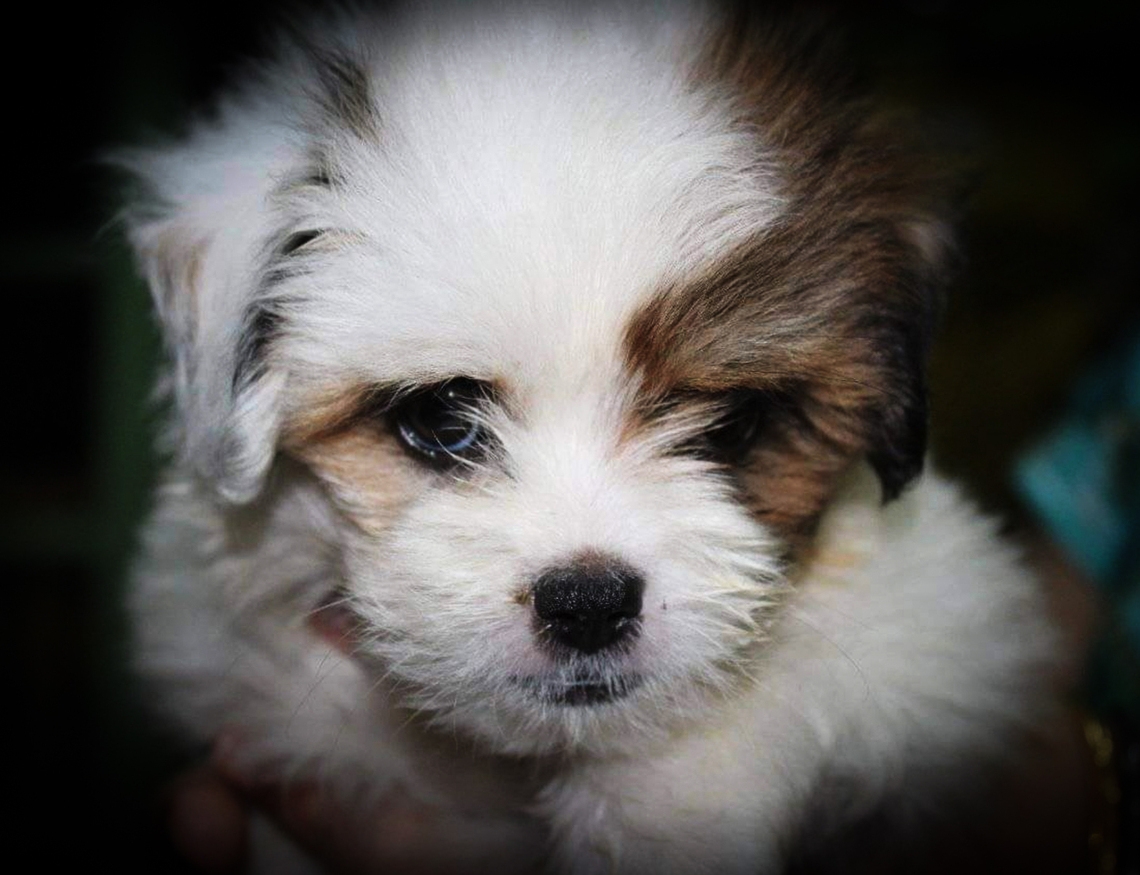
Malshi
The Malshi is one of the smaller designer crossbreeds originating in the US, which is growing in popularity. The breeds that make up the Malshi are the Maltese and the Shih Tzu.
The Malshi comes in a variety of sizes, shapes, colours and coat types, but in all cases this is a small companion dog. This crossbreed can be a first cross (with one Maltese and one Shih Tzu parent), they can be bred back to one of the original breeds, or be two Malshis bred together.
The need-to-know
- Dog suitable for non-experienced owners
- Basic training required
- Enjoys gentle walks
- Enjoys walking half an hour a day
- Little toy dog
- Minimum drool
- Requires grooming daily
- Non hypoallergenic breed
- Chatty and vocal dog
- Not a guard dog
- Great with other pets
- May require training to live with kids
Personality

Like most crossbreeds, the personality of a Malshi depends on the parents and how they have been bred and reared, but both parents are affectionate companion dogs who bond closely to their owners.
Nutrition and Feeding
Toy dogs have a fast metabolism, meaning they burn energy at a high rate. Because of their small stomachs, that they must eat little and often. Small-breed foods are specifically designed with appropriate levels of key nutrients and smaller kibble sizes to suit smaller mouths. This also encourages chewing and improves digestion. Your dog's diet needs to have the right balance of all the main nutrient groups including a constant supply of fresh water. It's important to conduct regular body condition scores to ensure you keep your dog in ideal shape, and remember to feed him at least twice daily in accordance with the dog feeding guidelines of his particular food.
Exercise
As long as they have plenty of owner interaction, the Malshi will be happy with half an hour to an hour’s walking each day.
Ideal Owner
The Malshi would suit an owner who lives on their own, or a family with older sensible children who may have a smaller property and who want an affectionate dog who doesn’t need a great deal of exercise. They do not like to be left alone and so would need an owner who is either at home most of the time or can take their dog with them wherever they go.
Other Information
History and origins
Like many of the designer crossbreeds, the Malshi originated in the United States in a quest to find a small companion dog that would fit into any family’s lifestyle no matter how small their home and garden. The two breeds that go into the formation of the Malshi are the Maltese and the Shih Tzu. Maltese Country of Origin: Malta This is one of the earliest of the small companion dog breeds and they may well have existed in Malta for hundreds of years, although the earliest records are from the early 1800s where they became known as lapdogs of the nobility and were frequently seen in paintings of the time. Throughout the 19th and 20th centuries they became increasingly popular both in Malta and wider afield, and thanks to both their appearance and their temperament they quickly found fans around the world, first appearing as a show dog in England in 1859. Shih Tzu Country of Origin: China The Shih Tzu we know and love today is itself an ancient crossbreed having been created within the walls of the Forbidden City in the 17th century from crossing the Lhasa Apso from the monasteries of Tibet with an early form of the Pekinese. The resulting dogs, called Lhasa Lion Dogs, remained hidden away from the eyes of the West until the 20th century when the Peking Kennel Club was formed and the Lhasa Lion Dogs were shown for the first time alongside the Lhasa Apso. It wasn’t until the 1930s that these dogs found their way to England but it was clear they were quite different from Lhasa Apso. The types that had the rounder skull and short muzzle became known as the Shih Tzu and a breed in their own right. The Malshi can have any combination of the two breeds in their appearance, behaviour and temperament.
Health and common issues
One aim with crossbreeds is to dilute or eliminate any inherited health issues that may exist within one or other of the breeds. This dilution or elimination is only likely if only one parent is the carrier of any particular condition, and where this is a first cross (F1). As this can’t always be guaranteed, all parents should be health tested prior to breeding: Maltese: there are no required health tests but eye testing should be considered and like many small breeds can be prone to luxating patellas. Shih Tzu: they are also prone to luxating patellas, and are prone to dental problems and eye conditions. They also are a brachycephalic breed and so can have the health problems and breathing difficulties associated with a shortened skull and flattened face. Information on health tests for both breeds can be found on the Kennel Club’s website or find out more about brachycephalic breeds here.
Potential issues
Separation related behaviour problems are very common in the Malshi. The Malshi can be a bit of a barker - especially if bored or if left alone. Toilet training can be slow in this breed and so owners need to be patient and consistent.
Space requirements
This is a small dog who can live in a flat or a smaller property as long as they have access to the outdoors for toileting and walks.
Training malshi
The Malshi is far cleverer than many people think (or than they will let on!) and they will enjoy learning tricks and games. They should be trained to walk on a lead and harness as well as come back when called. This is a breed that needs early and ongoing dog socialisation so they gain confidence with people and other dogs.
Family friendly dog breeds
The Malshi makes a fun, affectionate companion but as they are small and rather delicate, they suit families with older sensible children. They are often happier with one person.
Did you know?
Thanks to their low shedding, the Malshi are a popular breed for people with allergies.