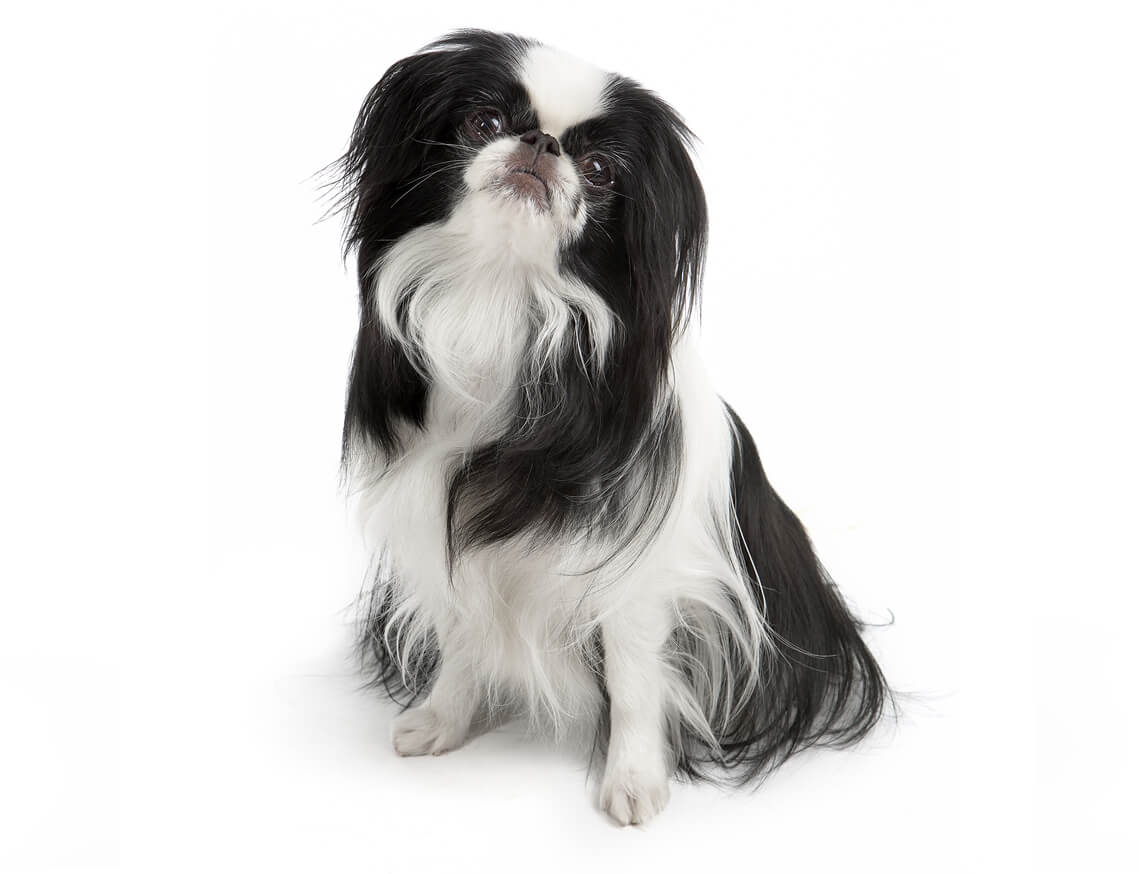
Japanese Chin
The Japanese Chin is an elegant, aristocratic, and compact little dog with a profuse coat. As a short-faced breed, they should have large eyes and open nostrils giving an appealing if slightly astonished-looking expression. The soft, silky coat is long and straight.
The need-to-know
- Dog suitable for non-experienced owners
- Basic training required
- Enjoys gentle walks
- Enjoys walking half an hour a day
- Little toy dog
- Some drool
- Requires grooming every other day
- Non hypoallergenic breed
- Quiet dog
- Not a guard dog
- Great with other pets
- Great family dog
Personality

The Japanese Chin is a happy, intelligent and lively little dog. Bred to be a companion, they thrive with human company and struggle to cope with separation from their family members. Affectionate and gentle, and undemanding as far as exercise goes, they are full of character despite their tiny size.
History and Origins
Country of Origin: Japan
The Japanese Chin is one of several tiny, hugely appealing toy dogs kept as companions and given as diplomatic gifts between royalty, nobility and families of high standing. Various theories exist as to their true origins, with suggestions they came from China, Korea or via traders from the West but all theories link them closely with both royalty and Eastern monastic life.
Nutrition and Feeding
Toy dogs such as the Japanese Chin have a fast metabolism, meaning they burn energy at a high rate, although their small stomachs mean that they must eat little and often. Small-breed foods are specifically designed with appropriate levels of key nutrients and smaller kibble sizes to suit smaller mouths. This also encourages chewing and improves digestion. Discover more about how to offer your dog a balanced diet with our easy-to-follow guide.
Exercise
The Japanese Chin will not require much daily dog exercise, however around half an hour a day should be given, plus training and mental stimulation. This is an intelligent little breed and although exercise in very weather should be avoided due their flattened face and the breathing problems this can cause. Time should be spent on training and mental stimulation daily to keep this clever little dog’s mind active and satisfied. Most of their exercise however will be had following their beloved owner absolutely everywhere they go.
Other Information
Health and common issues
The flat face of the Japanese Chin means they may be more prone to breathing problems. Over-exertion and over-heating are therefore to be avoided. Like many small dog breeds, they can suffer from kneecaps that may temporarily slip out of place (luxating patellas).
Space requirements
Compact and cobby, the Japanese Chin can live in small homes very happily however a secure garden is a must as these small dogs are able to slip through the tiniest of gaps. Town or country, the Japanese Chin won’t care as long as their people are always around.
Training japanese chin
The Japanese Chin is perfectly capable of learning quickly and should be trained in all the useful life skills. Many enjoy learning some fun tricks as well, so make sure you add them to your dog training routine as well. Positive reinforcement using food, toys, and the opportunity to perform enjoyable behaviours will help to engage this bright little dog. Good socialisation with other dogs, household pets and children (along with care and management) is vital to give this small dog the confidence they need to navigate life in a world that is giant to them!
Best family dog breeds
Being small, delicate and sensitive, the Chin is better suited to older families, child-free homes or those with older sensible children. With care they can live in with a busy or quiet household as long as they can accompany their owners wherever they go as the Japanese Chin is truly a companion dog and won’t do well left alone. While many dogs are traditionally thought of as being good with children, all dogs and children need to be taught to get on with each other and be safe together. Even so, dogs and young children should never be left alone together and adults should supervise all interactions between them.
Did you know?
The Japanese Chin was developed to resemble both in looks and behaviour, a cat-dog hybrid. The word ‘Chin’ means cat-like, and they have been noted for their feline-like behaviours, being remarkably silent and washing their faces with the front paws. They are also agile jumpers and deft climbers.