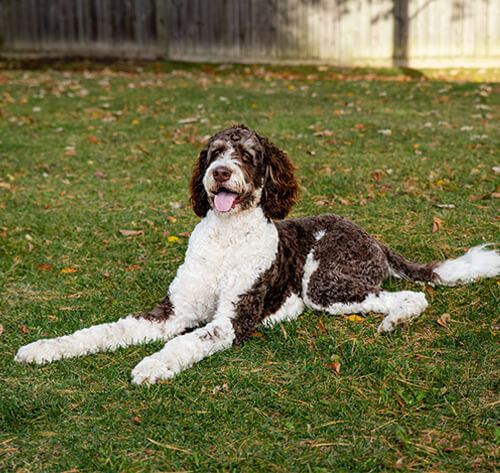
Bernedoodle
The breeds that make up the Bernedoodle are the Bernese Mountain Dog and the Standard Poodle, but sometimes a Miniature Poodle is used to produce a smaller dog. The aim of this cross is to get a Bernese Mountain Dog type with the enchanting natures of both, that doesn’t shed or drool so much and lives longer.
In theory, the Bernedoodle can be a first cross (with one Bernese Mountain Dog parent and one Poodle parent), can be bred back to one of the original breeds or be two Bernedoodles bred together. In reality, this is a rare cross and as such is usually a first cross only (F1), so there is slightly more consistency in size, shape and temperament - but this depends on the breeder as such crossbreeds are often produced irresponsibly from ‘less than great’ parents or even parents of dubious breeding themselves.
If you are considering this cross, make sure you buy a puppy from a responsible and ethical breeder.
The need-to-know
- Dog suitable for owners with some experience
- Some training required
- Enjoys gentle walks
- Enjoys walking one to two hours a day
- Giant dog
- Some drool
- Requires grooming daily
- Non hypoallergenic breed
- Chatty and vocal dog
- Not a guard dog
- May require training to live with other pets
- Great family dog
History and Origins

The Bernedoodle, while more popular in the US and Canada, is an unusual crossbreed in the UK - given the relative scarcity of the Bernese Mountain Dog and the breed club’s desire to protect the breed. However, the Bernedoodle was first intentionally bred by Sherry Rupke of Swissridge Kennels in 2003, as she wanted to combine the Poodles clever and goofy personality with the unfaltering loyalty of the Bernese Mountain Dog.
Nutrition and Feeding
If you have a large Bernedoodle, they’ll have significant appetites and will benefit from a different balance of minerals and vitamins, supporting different joint and cartilage needs. The Bernedoodle can be prone to bloating and stomach problems, so try feeding smaller, more frequent meals to help minimise the risk. Your dog's diet needs to have the right balance of all the main nutrient groups including a constant supply of fresh water. It's important to conduct regular body condition scores to ensure you keep your dog in ideal shape, and remember to feed them at least twice daily in accordance with the feeding guidelines of their particular food.
Exercise
It’s difficult to predict the exercise needs of this cross. The Poodle is an active working dog who needs plenty of exercise, thrives on having a job to do, and loves training and exercising their busy brains. The Bernese Mountain Dog is far calmer and laid-back and is often happy lying around watching what is going on. So, you could end up with a light-ish build dog who needs a lot of exercise and training, or you could end up with a heavier dog whose body and brain is more that of a friendly couch potato! Even an active Bernedoodle may not mature for quite some time, so short periods of exercise several times a day are far better so as not to permanently damage growing bones and joints. If your Bernedoodle inherits the thick coat of the Bernese Mountain Dog, it’s worth noting that these are designed to withstand the cold of the Alps and so they don’t cope well in the heat of the summer. With this in mind, exercising first thing in the morning and last thing in the evening when the sun is cooler may be necessary. Take advice from both your breeder and your vet.
Other Information
Health and common issues
One aim with crossbreeds is to dilute or eliminate any inherited health issues that may exist within one or other of the breeds. This dilution or elimination is only likely if only one parent is the carrier of any particular condition, and where this is a first cross (F1). As this can’t always be guaranteed, all parents should be health tested prior to breeding: Bernese Mountain Dog - eye tests and hip and elbow scoring should be done, and there are several DNA tests that should be done. Also, this breed takes a long time to reach maturity and is one of the shortest-lived breeds, so prospective owners should be prepared for the possibility of losing their dog earlier than they might expect. Poodle - eye tests and hip scoring should be done. Information on DNA health tests for both breeds can be found on the Kennel Club’s website and via their respective breed clubs.
Space requirements
The Bernedoodle varies in size quite drastically, but for larger types, a good-sized living space will be required. Plus, they will appreciate a large garden and access to the great outdoors.
Training bernedoodles
For larger Bernedoodles, they will need training so you can walk them easily on a lead and ensure they will come back to you when you call them. They also need to learn not to jump up at people - or knock them over in their enthusiasm! The two breeds that go into the Bernedoodle are very owner-oriented and so training and handling should always be positive and reward-based. It’s important to train a Bernedoodle to enjoy handling and grooming (as they will need a lot of it). Given the Poodle has a working gundog background, they should be well socialised with cats (who they can learn to live with very happily) but they should be watched with caution around other small animals and birds.
Best family dog breeds
For larger Bernedoodles, they will need training so you can walk them easily on a lead and ensure they will come back to you when you call them. They also need to learn not to jump up at people - or knock them over in their enthusiasm! The two breeds that go into the Bernedoodle are very owner-oriented and so training and handling should always be positive and reward-based. It’s important to train a Bernedoodle to enjoy handling and grooming (as they will need a lot of it). Given the Poodle has a working gundog background, they should be well socialised with cats (who they can learn to live with very happily) but they should be watched with caution around other small animals and birds.
Did you know?
If the Bernedoodle is sourced from a reliable breeder, and well-trained from puppyhood, they will make fabulous family dogs, be a total joy to own and will get on with everyone. In other words, almost the perfect dog!