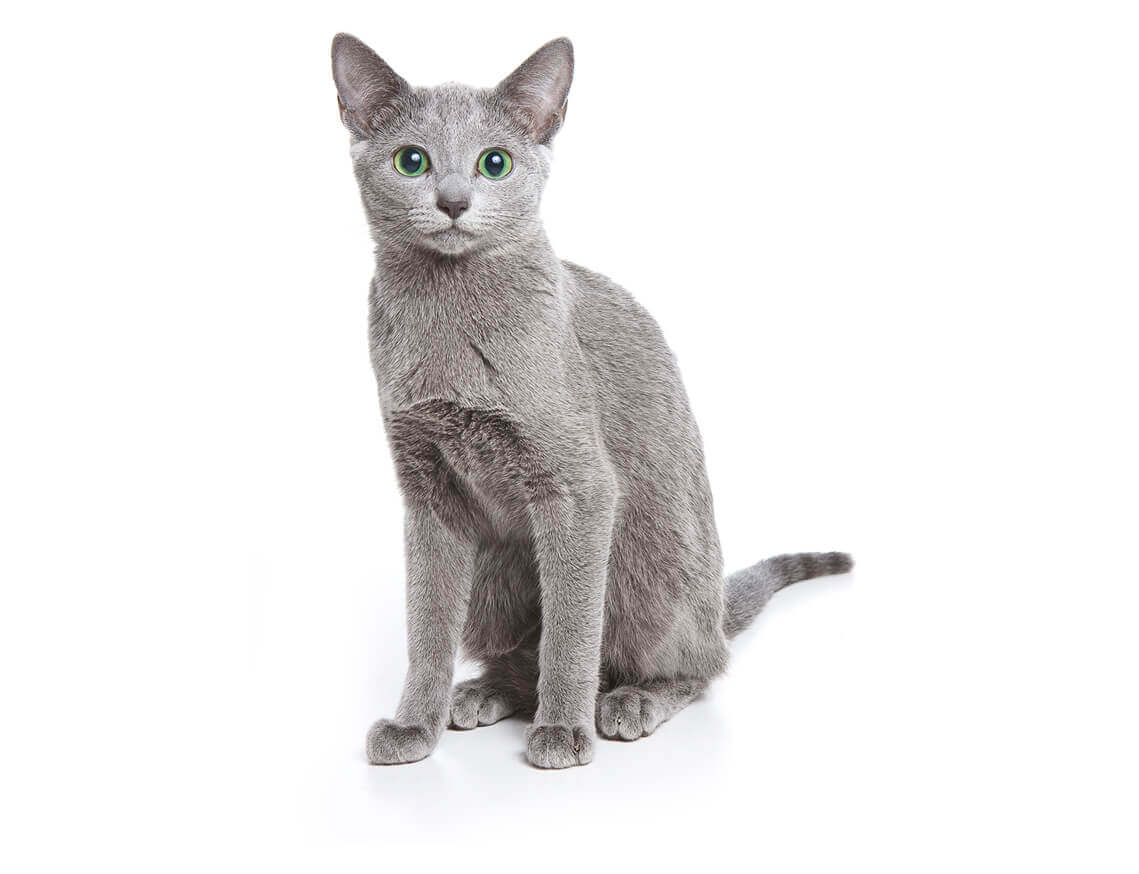
Russian Blue
The Russian Blue cat is medium to large with an elegant, graceful body and long, slim legs. The cat walks as if on tip-toes. The head is wedge-shaped with prominent whisker pads and large ears. The vivid green eyes are set wide apart and are almond-shaped. The coat is double with a very dense undercoat and feels fine, short, and soft. In texture, the coat of the Russian Blue cat is very different from any other breed and is the truest measure of the breed. Although named the Russian Blue, black and white Russian cats do sometimes appear. In the most popular blue variety, the coat colour is a clear even blue with a silvery sheen.
The need-to-know
- Playful and curious cat
- Friendly but independent cat
- Quiet cat
- Lean and elegant cat breed
- Requires grooming once a week
- Non hypoallergenic breed
- Needs some out-door space
- May require familiarisation before living with children
Personality

Russian Blue cats are quiet and sensitive, sometimes shy and reserved, but are said to be tremendously loyal to their chosen human being. They may be cautious of strangers and take time to develop friendship with humans. Once settled in a loving environment, they love to play with toys and enjoy jumping, climbing, and racing around and are extremely agile and light-footed.
History and Origins
Country of Origin: Russia
The Russian Blue cat was originally known as the Archangel Cat because it was said to have arrived in Europe aboard ships from the Russian port of that name (Arkhangel'sk). It has also been known as the Spanish Cat and the Maltese Cat, particularly in the US where the latter name persisted until the beginning of the century. There is, however, strong evidence linking the cat with Russia. Large numbers of cats with similar coat colours are found in Scandinavia and their dense coat is indicative of living in a northern climate. Although blue is considered the typical colour of this breed, black and white Russian cats are known. These colours arose during World War II, when the few remaining Russian Blue cats were crossed with the British Blue and the Siamese to maintain numbers.
Nutrition and Feeding
Every cat is unique and each has their own particular likes, dislikes, and needs when it comes to food. However, cats are carnivores and every cat must obtain 41 different and specific nutrients from their food. The proportion of these nutrients will vary depending on age, lifestyle, and overall health. So it's not surprising that a growing, energetic kitten needs a different balance of nutrients in her diet than a less active senior cat. Other considerations to bear in mind are feeding the right quantity of food to maintain 'ideal body condition' in accordance with feeding guidelines and catering to individual preference regarding wet or dry food recipes.
Other Information
Health and common issues
The Russian Blue cat breed seems to be healthy.
Best cat breeds for children
While this breed is not widely recognised as one of the best breeds for children, all cats are different and with the proper familiarisation may still be able to live with children.