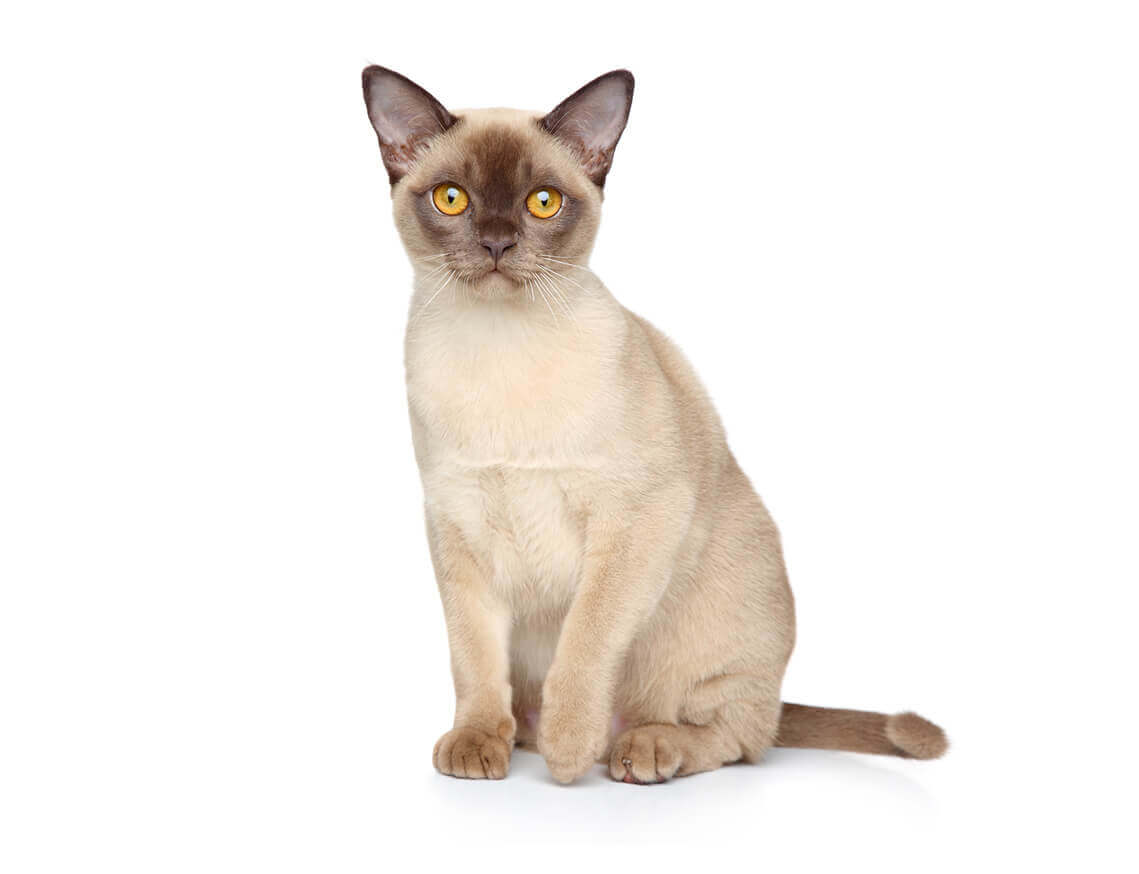
Burmese
The Burmese cat is medium-sized, with a rounded head and an elegant yet well-muscled body. The breed is not as large and sturdy as the British Shorthair cat breed nor as slender and dainty as Siamese cats. The eyes are large and lustrous and may be any shade of yellow often seeming to change in variations in light quality. The tail is straight and ends in a rounded paintbrush tip. The fine, short glossy coat is a distinctive feature of the Burmese cat and lies close to the body. The Burmese cat comes in 10 colours but in all colours, the underparts will be lighter than the back and the shading will be gradual.
The need-to-know
- Highly active and inquisitive cat
- Sociable and dependent cat
- Very talkative cat
- Lean and elegant cat breed
- Requires grooming once a week
- Non hypoallergenic breed
- Outdoor cat
- Great family cat
Personality

The Burmese cat is an extremely friendly and affectionate creature that needs attention from human beings to be happy. The Burmese cat breed is very demanding and Burmese cats will follow owners around the house crying for attention – they might even climb their owner's leg begging to be picked up and cuddled! As very vocal cats, they will often greet owners when they return home or demand what they want and join in with all activities. Loyal to their owners, they are sometimes known as the 'dog cat' as many are happy to play retrieve. They are very intelligent and can work out problems such as opening doors are often successful escape artists!
History and Origins
Country of Origin: Burma
A dark brown cat resembling a Siamese cat in shape was first taken from the far east to California in the 1930s. As there were no other Burmese cats in America at the time, the 'Wong Mau' breed was mated with a Seal Point Siamese cat. Through selective breeding, a new dark-coated breed became known as the Burmese cat we know today. The Burmese cat was first recognised as a breed in America and came to Europe in the 1940s. Breeding programmes have since developed a range of coat colours.
Nutrition and Feeding
Every cat is unique and each has their own particular likes, dislikes, and needs when it comes to food. However, cats are carnivores and every cat must obtain 41 different and specific nutrients from their food. The proportion of these nutrients will vary depending on age, lifestyle, and overall health. So it's not surprising that a growing, energetic kitten needs a different balance of nutrients in her diet than a less active senior cat. Other considerations to bear in mind are feeding the right quantity of food to maintain 'ideal body condition' in accordance with feeding guidelines and catering to individual preference regarding wet or dry food recipes.
Other Information
Health and common issues
Burmese cats are quite robust healthwise but some lines of the breed do seem to be susceptible to diabetes mellitus. Hypokalaemic polymyopathy (muscle weakness due to low levels of blood potassium) is seen occasionally in young Burmese cats. A few Burmese cats have developed an unusual condition called feline orofacial pain syndrome. This condition causes exaggerated licking and chewing movements, and pawing at the mouth, which can be very distressing for the cat. In the USA there has been a problem with a head and brain deformity, but this is not reported in other countries. Some lines of Burmese cat breeds also have unusual eating habits and will eat wool garments and other inedible items (this is known as pica).
Best cat breeds for children
While this breed tends to be excellent with kids, each cat has a different personality based on training and life experience. Please consult the adoption organisation, if you are adopting for details on a specific cat’s character.